
Orlando Business Communication Solutions

January 21, 2026
 490 views
 0 comments
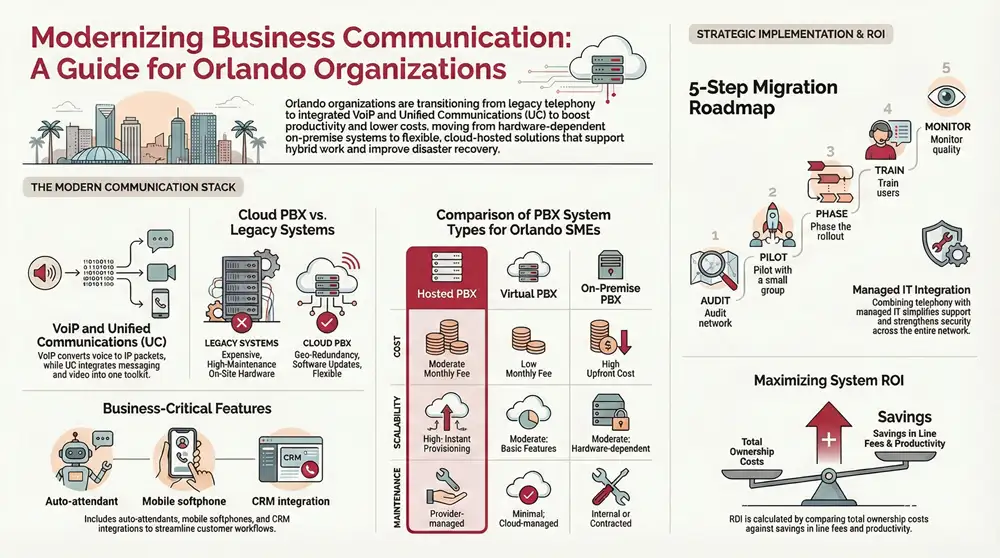
Business communication solutions bring together telephony, collaboration apps, and network services into a single system that boosts productivity, lowers costs, and improves customer experience for Orlando organizations. This guide walks through VoIP, cloud phone systems, and unified communications (UC) with practical steps and Orlando-specific considerations so local decision-makers can compare options for offices, remote staff, and multi-site setups.
You’ll get a clear definition of each technology, how they work in practice, which features matter here in Orlando, and a migration plan designed to minimize disruption. We map VoIP fundamentals and benefits, contrast cloud PBX with legacy systems, unpack UC components and UCaaS use cases, look at managed communications and integrations with managed IT and cybersecurity, and offer comparative guidance to pick the right business phone system. Local performance notes, vendor evaluation criteria, and where local managed services can help are included throughout.
What Are Orlando VoIP Services and How Do They Benefit Your Business?

Orlando VoIP services convert voice into IP packets and carry calls over the internet, delivering lower per-call costs and richer features than legacy PSTN lines. The system depends on SIP signaling and RTP media streams; when paired with sufficient bandwidth and solid QoS settings, VoIP gives dependable voice quality plus features like voicemail-to-email and mobile softphones. For businesses in Orlando, VoIP lowers trunking expenses, supports hybrid and remote workers, and makes adding or moving lines quick without extra on-site hardware. When evaluating providers, check SIP trunk reliability, response times for local support, and compatibility with your existing network gear.
Preparing your network is the first step for a successful VoIP rollout in Orlando — the following subsection outlines technical requirements and a simple readiness checklist.
Understanding VoIP Technology for Orlando Businesses
VoIP uses SIP to set up calls and codecs to compress audio so voice runs like any other application on your network instead of over a dedicated circuit. Key network requirements include enough upstream bandwidth per concurrent call, QoS or traffic-priority rules to prevent packet loss, and low jitter and latency to keep conversations natural. Softphone apps give mobility on phones and desktops; desk phones offer a familiar experience — both use the same SIP accounts and registration. Start by auditing your ISP, measuring bandwidth headroom, and confirming interoperability with your SIP trunk provider before buying equipment or services.
Those network checks lead directly into the practical advantages Orlando businesses realize when they switch to VoIP.
Key Advantages of VoIP Services in Orlando
VoIP delivers measurable benefits beyond cost savings — it increases operational agility and brings feature-rich communication tools to your team.
- Lower Call and Infrastructure Cost: Moving voice to IP cuts many line fees and reduces reliance on expensive on-site PBX hardware.
- Scalability and Flexible Pricing: Add or remove lines quickly to match seasonal demand or growth without long lead times.
- Advanced Features: Auto attendants, intelligent routing, voicemail-to-email, and mobile softphones improve responsiveness and efficiency.
- Remote and Hybrid Support: Staff can use business numbers from anywhere, keeping a consistent customer experience and unified routing.
- Integration Potential: VoIP connects with CRM and document systems to streamline workflows and surface customer context during calls.
- Disaster Recovery and Redundancy: Cloud-based SIP services can fail over to alternate data centers or cellular links to preserve uptime.
These benefits point to clear provider evaluation criteria — SLAs, feature parity, and local support — which we examine next in the cloud phone systems section.
How Do Cloud Phone Systems Enhance Business Communication in Orlando?

Cloud phone systems (Cloud PBX) host telephony off-site and deliver enterprise features over the internet, removing much of the on-premise hardware burden. The biggest advantages are predictable operational costs, built-in redundancy, rapid provisioning, and tighter integration with collaboration tools. For Orlando organizations, cloud PBX reduces local PBX maintenance, accelerates site rollouts, and supports distributed teams with unified dialing and presence. When comparing vendors, prioritize video conferencing quality, mobile app experience, SMS support, and enterprise-grade call routing.
Below is a concise comparison of Cloud PBX features versus traditional PBX to highlight operational differences and security implications.
That feature comparison clarifies trade-offs and sets up the practical migration steps Orlando businesses should follow.
Features of Cloud PBX vs. Traditional Phone Systems
Cloud PBX centralizes feature management and delivers capabilities that once required expensive on-site equipment, making updates and scaling far simpler for SMBs.
- Cloud PBX delivers software-driven features — multi-site routing, near-instant failover, and over-the-air updates — while traditional PBX depends on local hardware upgrades and manual maintenance.
- Redundancy and disaster recovery are built into cloud carriers via geo-redundant data centers; legacy systems need costly secondary hardware and backup trunks.
- Traditional PBX has higher upfront hardware costs, while cloud solutions convert capital expense into predictable monthly subscriptions and lower on-site maintenance.
That comparison helps explain why many Orlando organizations prefer cloud-hosted platforms and points to a phased migration approach to avoid business interruption.
Steps to Migrate to Cloud Phone Systems in Orlando
A structured migration reduces risk and improves adoption for Orlando teams. Follow these practical steps.
- Assess Network and Bandwidth: Audit internet capacity, estimate concurrent call volume, and confirm QoS readiness for SIP and media flows.
- Choose Provider and Pilot: Pick vendors with local support and run a pilot group to validate call quality, features, and integrations.
- Plan Phased Rollout: Move locations in stages, starting with non-critical departments to limit impact and work out issues.
- Train Users and Provision Devices: Offer role-based training and deploy softphones and handsets with preconfigured SIP profiles for a smooth cutover.
- Monitor and Optimize: After cutover, monitor MOS, jitter, and packet loss; tune QoS, codecs, and routing policies for consistent quality.
A managed migration partner can handle staging, SIP trunk procurement, and cutover coordination to keep the transition smooth, as covered in the managed services section.
What Is Unified Communications and Why Is It Essential for Orlando Companies?
Unified Communications (UC) combines telephony, messaging, video, and presence into connected workflows that remove friction between teams and customers. UC shortens resolution times, improves collaboration for hybrid teams, and delivers a consistent customer experience across channels — all benefits that matter for Orlando companies. The core pieces — voice, video conferencing, team messaging, and presence — work together to replace fragmented tools with contextual interactions. Integrations with CRM and document systems extend UC’s impact by surfacing customer context during conversations.
The next section breaks down the main UC components and how they interact in everyday workflows.
Components of Unified Communications Solutions
UC brings multiple communication modes into a single toolkit that reflects how teams actually work today.
- Telephony: Enterprise call routing, IVR, and call analytics for customer-facing operations.
- Team Messaging and Presence: Real-time chat with status indicators that guide routing and collaboration.
- Video Conferencing and Screen Sharing: Reliable meetings and remote troubleshooting with persistent or scheduled rooms.
- Integrations: CRM and document links that surface customer history and context during calls and chats.
Packaging these components as UCaaS reduces tool-switching and saves time — a real benefit for distributed Orlando teams. Below are practical use cases.
Improving Team Collaboration with UCaaS in Orlando
UCaaS helps Orlando teams — sales, field service, and multi-location staff — work faster and with clearer context. For sales, presence and CRM integrations reduce handle time by surfacing account history before calls. For field service, mobile apps with video and screen sharing speed diagnosis and cut repeat visits. Measurable wins include fewer internal emails, quicker case resolution, and higher first-call resolution rates. Track metrics like average handle time, meeting frequency, and ticket resolution to quantify UCaaS value and fine-tune policies.
Those collaboration gains often point organizations toward outsourcing options, which we cover in the managed communications section.
How Can Managed Communication Solutions Support Orlando Businesses?
Managed communication services provide outsourced monitoring, support, and day-to-day administration for phone systems, removing operational burden and centralizing accountability. Typical offerings include SLA-backed support, proactive monitoring, firmware and software updates, and optional bundled cybersecurity protections. For Orlando businesses without deep telecom expertise in-house, managed services lower downtime risk and keep configurations consistent across sites. The core value is predictable monthly costs, a single escalation path, and faster remediation when issues arise.
The table below shows sample managed phone service bundles and the business benefits they deliver.
This bundling approach shows how managed communications align with broader managed IT responsibilities, which the following subsections detail.
Benefits of Managed Business Phone Services in Orlando
Managed phone services remove routine telephony work from internal teams by providing specialized expertise, monitoring, and rapid incident response. Businesses benefit from predictable costs, access to vendor-grade tools, and a single escalation path that shortens mean time to repair. For Orlando firms with seasonal swings or multiple locations, managed providers handle scaling and failover planning and often coordinate with ISPs to resolve call-quality issues. That allows your staff to focus on core business while specialists maintain the communications stack.
Understanding the integration points helps explain why combining communications with managed IT improves security and reliability.
Integrating Communication with Managed IT Services
Bringing communications into managed IT creates a single support model for network, security, and telephony — improving performance and simplifying compliance. Key integration points include firewall and NAT rules for SIP, QoS policies on switches and routers to prioritize voice, identity management for single sign-on across UC apps, and centralized logging for backups and compliance. Define responsibilities clearly — who manages SIP trunks, who patches endpoints, and who runs failover tests — to avoid gaps. A unified vendor that covers both managed IT and communications can speed troubleshooting and reduce finger-pointing when incidents cross network and telephony layers.
These integration benefits influence vendor selection and system-type decisions described in the next section.
Which Business Phone Systems Are Best Suited for Orlando Small and Medium Enterprises?
Picking the right phone system depends on an SME’s priorities around cost, control, and scalability. Hosted PBX is often the best fit for growing businesses that want full features with minimal on-site hardware; virtual PBX works well for microbusinesses needing simple call routing; on-premise systems make sense when regulatory needs or ultra-low latency require local hardware. Key decision factors include TCO, expected growth, internal IT capacity, and the availability of local support.
The table below compares Hosted PBX, Virtual PBX, and On-Premise PBX across attributes that matter to Orlando SMEs.
This comparison lays the groundwork for ROI calculations and cost trade-offs discussed next.
Comparing Hosted PBX, Virtual PBX, and On-Premise Systems
Hosted PBX combines rich features with provider-managed maintenance, making it attractive for multi-site or growth-minded Orlando businesses that prefer operational simplicity. Virtual PBX delivers core call routing and auto-attendant features at a lower price point, ideal for single locations with basic needs. On-premise systems give you direct control and can support specialized integrations or compliance requirements, but they require higher upfront capital and local maintenance. Balance deployment complexity, desired control, and internal staffing capacity when choosing between short-term savings and long-term flexibility.
To evaluate ROI, consider the cost elements listed in the next subsection and apply a straightforward calculation.
Cost and ROI Considerations for Orlando Businesses
Calculating ROI means totaling ownership costs — hardware, SIP trunks, handsets, installation labor, ongoing management fees, and potential downtime — and comparing that to expected savings. A basic ROI approach is: (Baseline Annual Telephony Cost − Annualized New System Cost) ÷ Annualized New System Cost = ROI. Factor in intangible gains like higher employee productivity, shorter hold times, and faster sales cycles to capture full value. To shorten payback, bundle phone systems with managed IT or office equipment and spread costs with phased migrations.
These guidelines help Orlando SMEs select the system profile that best fits operational needs and budget realities.
Smart Technologies can help Orlando businesses with local assessments, managed migrations, and bundled solutions that combine communications, managed IT, cybersecurity, and office equipment. We produce quotes for organizations seeking IT services, cybersecurity, and office equipment and can provide a free assessment outlining migration paths and cost estimates.
If you’re ready to explore vendor options or get a tailored quote, the final section explains how to request a proposal and what to prepare before contacting a local provider.
Smart Technologies prepares quotes for businesses seeking IT services, managed cybersecurity, and office equipment; to request one, contact the company by phone or email. Our approach emphasizes integrated device technology and tailored solutions — a single source for managed cybersecurity, IT services, and office equipment that simplifies procurement and vendor management. When requesting a quote, gather current call volumes, number of users, desired features (video, SMS, CRM integrations), and any known network constraints to speed an accurate assessment. Supplying that information helps us deliver a focused recommendation for your Orlando operations.
771 Fentress Blvd Suite 10, Daytona Beach, FL 32114 is the listed business address for local correspondence; contact details for quote requests are available via phone and email. The company phone is (386) 261-8323 and the contact email is contact@smarttechfl.com. Use these contacts to arrange assessments, managed migration planning, and bundled equipment quotes.
Frequently Asked Questions
What factors should Orlando businesses consider when choosing a VoIP provider?
Look at SIP trunk reliability, local support responsiveness, and how well the provider integrates with your existing network and phone equipment. Compare feature sets — voicemail-to-email, call analytics, mobile app capabilities — and review SLAs for uptime and support response times. Local presence or a nearby support partner can make a big difference for fast issue resolution.
How does Unified Communications (UC) improve customer service for Orlando companies?
UC gives customer-facing teams one place to handle voice, video, and messaging, so reps see context fast and resolve issues sooner. Features like presence, call routing, and CRM integrations reduce handoffs and speed responses — which improves customer satisfaction and shortens resolution times.
What are the security considerations for cloud phone systems in Orlando?
Security best practices include strong encryption for calls and data, role-based access controls, and routines for patching and updates. Ask providers about disaster recovery, geo-redundancy, and data retention policies. Regular security audits and compliance with relevant standards (HIPAA for health-related data, for example) help protect sensitive information and maintain trust.
How can businesses measure the ROI of their communication solutions?
Measure both direct and indirect benefits: compare TCO (hardware, trunks, installation, management) against savings from reduced line fees and maintenance. Track productivity and service metrics — average handle time, first-call resolution, and employee time saved — plus customer metrics like NPS or CSAT to capture the broader impact.
What role do managed communication services play in business continuity?
Managed services provide proactive monitoring, rapid response, and failover planning that keep communications running during incidents. For Orlando businesses, that means fewer outages, faster recovery, and predictable support — all of which help maintain operations when unexpected events occur.
How can businesses ensure a smooth migration to cloud phone systems?
Follow a phased approach: validate network readiness, run a pilot group, and move departments in stages. Provide role-based training, preconfigure devices, and monitor call quality after cutover. Engaging a managed services partner to handle staging, SIP trunking, and cutover coordination will reduce risk and speed adoption.
What are the benefits of integrating communication with managed IT services?
Integration simplifies support and improves reliability by aligning network, security, and telephony responsibilities. It lets teams apply consistent QoS, identity management, and logging across systems, which speeds troubleshooting and enhances security. For Orlando businesses, a unified approach reduces downtime and streamlines vendor management.
Related Posts

— Short Term Copier Rental vs. Long Term Lease: Which Makes Sense for Your Situation?
— Your Office Copier Is a Security Risk: What Most Businesses in Daytona Beach and Orlando Don’t Realize