Ink Refills vs. Laser: A Cost Showdown

July 22, 2025
 592 views
 0 comments
AI Overview:
When it comes to printing, the real expense isn’t the printer itself—it’s what comes after. The article breaks down the hidden economics of printing and answers the question: Are laser printers cheaper than ink refills? The short answer: Yes—if you understand cost per page and long-term ownership.
The Real Cost Behind Every Page You Print
Are laser printers cheaper than ink refills? The short answer is yes, but only if you understand the full picture. Here’s what most business owners miss when comparing printing costs:
Quick Cost Comparison:
- Laser printing: 2-5 cents per black page, 15 cents per color page
- Inkjet printing: 7-15 cents per black page, 15-25 cents per color page
- Ink tank printing: 0.2-1 cent per black page, 5-10 cents per color page
Many business owners fall into the same trap. They see an inkjet printer for $100 next to a laser printer for $300 and assume they’re making a smart financial choice.
But here’s the reality: that $100 inkjet will cost you $165 to print 1,100 black pages, while the same job costs just $51 with a laser printer.
The problem isn’t the printer; it’s the refills. Inkjet manufacturers use the “razor and blades” model, selling the printer cheap to profit from the expensive ink cartridges you’ll buy for years.
As one frustrated user put it: “I’m frustrated that my Inkjet HP 8610 won’t let me print black & white when the Cyan cartridge has been depleted!” This kind of artificial limitation forces you to buy more ink even when you don’t need all the colors.
The average employee prints 34 pages daily. For your business, those printing costs add up fast. The math gets more complex when you factor in printing volumes, color needs, and newer technologies like ink tank printers.

The Lure of the Low Price Tag: Why We Buy Inkjet Printers
Picture this: You’re standing in the electronics aisle, and that bright yellow price tag catches your eye. “Inkjet Printer – Only $89!” Right next to it sits a laser printer with a much less cheerful $249 sticker. Which one would you grab?
If you’re like most people, you’d reach for the inkjet without a second thought. That’s exactly what manufacturers are counting on.
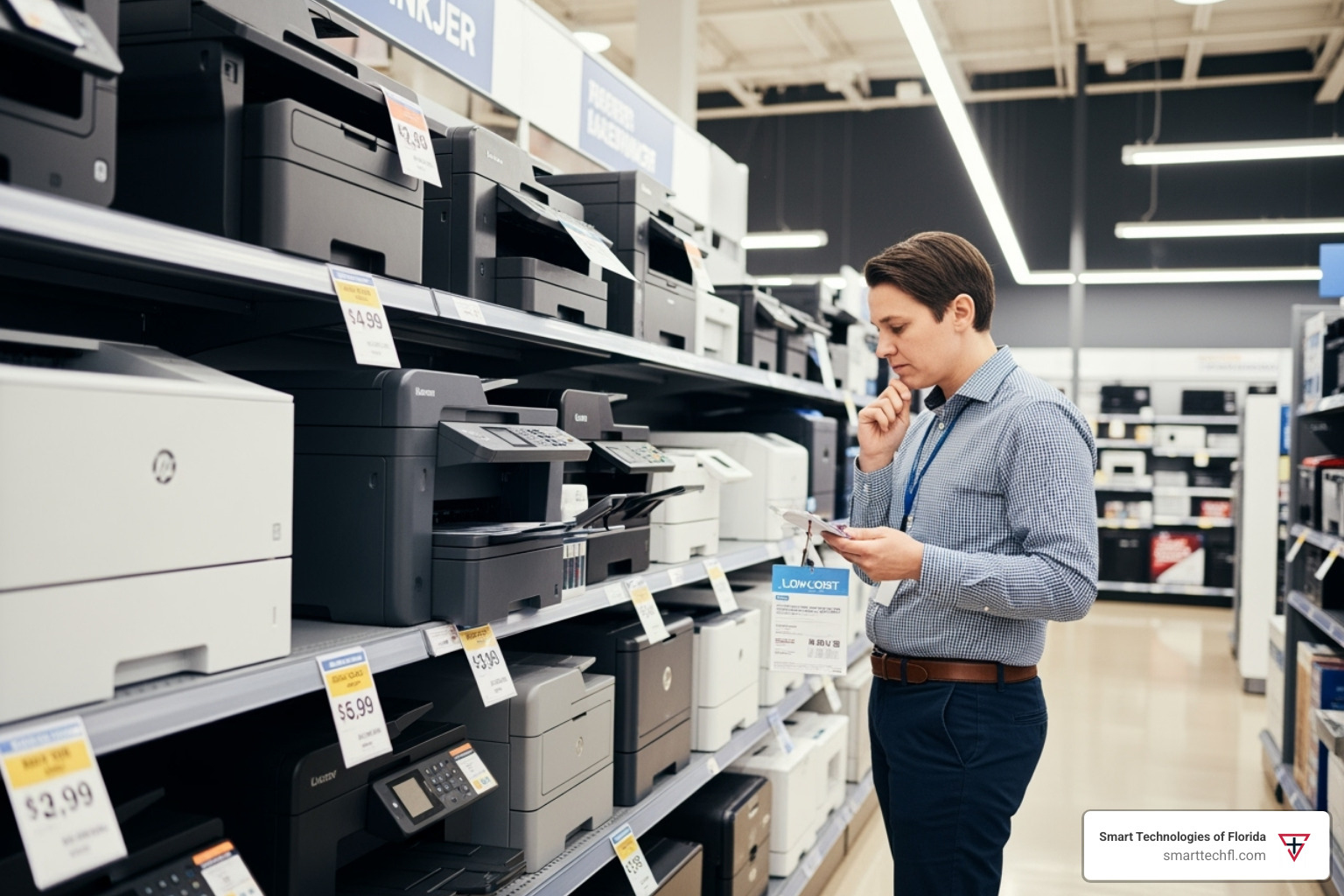
This classic shopping scenario plays out thousands of times every day. We see that low initial purchase price and think we’re getting a steal. Printer companies have perfected the razor and blades model. They practically give away the printer so they can sell you expensive ink cartridges for years to come.
It’s brilliant marketing, and it works because most of us don’t stop to ask the important question: Do Laser Printers Need Ink? The answer might surprise you and starts with understanding how these two technologies work.
Understanding the Core Technology
Think of inkjet technology like a tiny, precise paint sprayer. Inside those cartridges is liquid ink that gets pushed through microscopic nozzles smaller than a human hair. These nozzles spray thousands of tiny droplets onto your paper, building up text and images dot by dot.
Laser technology works completely differently. Instead of liquid ink, it uses powdered toner. A laser beam “draws” your document onto a special drum, attracting the toner. Then, a fuser unit uses heat transfer to melt the powder onto your paper.
These fundamental differences explain why laser printers cost more upfront, are faster, and, most importantly, why are laser printers cheaper than ink refills in the long run.
The Initial Cost: A Deceptive First Impression
Let’s talk numbers. Inkjet printer price ranges typically start around $60 for basic models and go up to about $400 for fancy ones. Most people buy something in the $100-$200 range.
Laser printer price ranges tell a different story. You’re looking at $200 minimum, with most decent models falling between $250-$500. That’s a significant jump from the tempting $89 inkjet.
But inkjets are cheaper to manufacture because they’re mechanically simpler, with no complex laser systems or heating elements. Laser printers require more sophisticated components like lasers, drums, and fusers, which cost more to build.
So yes, the upfront investment for a laser printer stings more initially. But remember the razor and blades model? That seemingly cheap inkjet is about to become very expensive.
The real question isn’t what you pay today, but what you’ll pay over the next few years. That’s where the math gets interesting.
Are Laser Printers Cheaper Than Ink Refills? The True Cost-Per-Page
Here’s where things get interesting. Are laser printers cheaper than ink refills? The answer is a resounding yes for most situations, but you must look beyond the cartridge’s sticker price.
The secret is understanding cost per page (CPP), the real measure of printing affordability. You calculate it by dividing the cartridge price by its page yield (how many pages it can print).
Think of it like buying coffee. A $20 bag that makes 40 cups costs 50 cents per cup. A $10 bag that makes 15 cups? That’s 67 cents per cup. The cheaper bag costs more in the long run.
The same logic applies to printers, and the numbers are eye-opening. While a laser toner cartridge might cost $60 compared to a $20 ink cartridge, the toner often prints 2,000 pages while the ink only manages 200. This makes laser printing 3 cents per page versus 10 cents for inkjet.
For businesses serious about Cost-Effective Printing Solutions, this math makes all the difference. High-volume printing especially favors laser technology, where superior page yields shine.
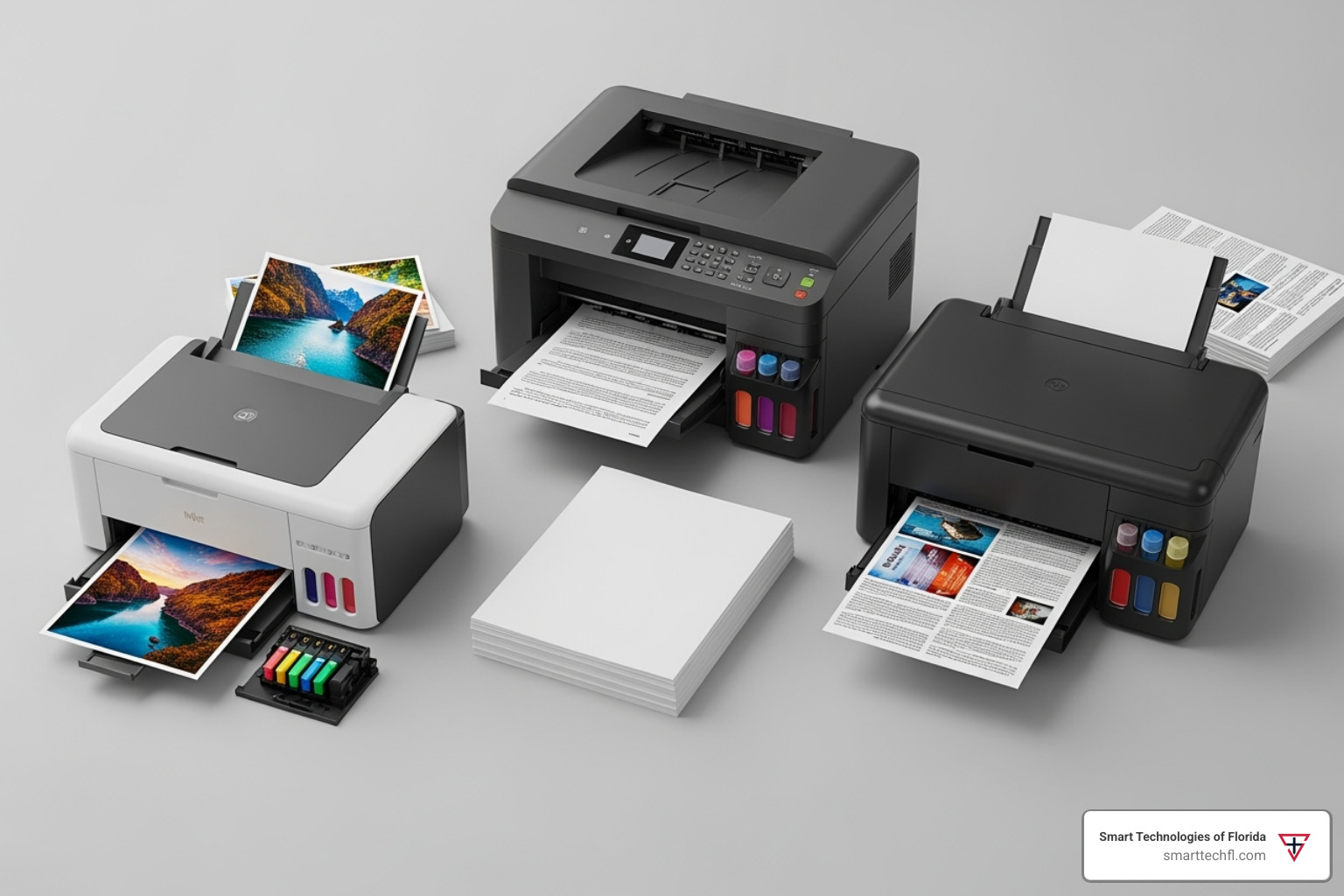
Here’s how the three main printer types stack up:
| Printer Type | Initial Cost | Black Cartridge Cost | Black Page Yield | Black CPP | Color Cartridge Cost | Color Page Yield | Color CPP |
|---|---|---|---|---|---|---|---|
| Standard Inkjet | $60 – $200 | $15 – $25 | 100 – 200 pages | 5 – 15 cents | $15 – $30 | 100 – 150 pages | 15 – 25 cents |
| Standard Laser | $200 – $400 | $50 – $70 | 1,000 – 2,000 pages | 2 – 5 cents | $50 – $60 (per color) | 900 – 1,100 pages | ~15 cents |
| Ink Tank Inkjet | $200 – $400 | $20 – $30 (bottle) | 4,000 – 7,500 pages | 0.2 – 1 cent | $20 – $30 (bottle) | 6,000 – 7,700 pages | 5 – 10 cents |
The difference becomes dramatic when you calculate real-world scenarios. Printing 1,100 pages with a budget inkjet costs $165 in ink, while the same job costs just $51 with a laser printer.
Calculating Your Black and White Printing Costs
For everyday business documents like reports and invoices, laser technology dominates the cost comparison. Most inkjet printers charge 7 to 15 cents per black page, often around the 10-cent mark.
Laser printers typically cost 2 to 5 cents per black page. The difference comes down to toner cartridge yield versus ink cartridge yield.
Here’s a real example: An HP LaserJet toner cartridge costs about $51 and prints 1,100 pages (4.6 cents per page). To print those same 1,100 pages with a typical inkjet using cartridges that cost $15 for 100 pages, you’d need 11 cartridges, totaling $165.
That’s more than triple the cost for identical text documents, making it clear why laser wins for text documents.
If your business prints mostly black and white documents, laser printers will save you significant money over time. The higher page yields of toner cartridges make each page much cheaper to produce.
The Color Printing Cost Dilemma
Color printing muddies the waters. Inkjet color CPP typically runs 15 to 25 cents per page, while laser color CPP hovers around 15 cents per page. At first glance, they seem equal.
However, it’s nuanced. Photo quality and graphics printing matter. Inkjet printers excel at blending liquid inks smoothly, creating superior photo prints. They also work with specialty papers like glossy photo stock, canvas, and fabric transfers.
When inkjet color can be more economical depends on what you’re printing. If you need professional-quality photos or print on unusual materials, inkjet might deliver better value, even if the raw cost per page is higher.
For everyday color documents like presentations and charts, laser printers often provide adequate quality at a more predictable cost. The separate color cartridges in laser printers also mean you only replace the colors you use.
The key is matching your needs to the technology. High-volume color document printing usually favors laser, while occasional photo printing might justify the inkjet premium.
Beyond the Refill: Hidden Costs and Maintenance Headaches
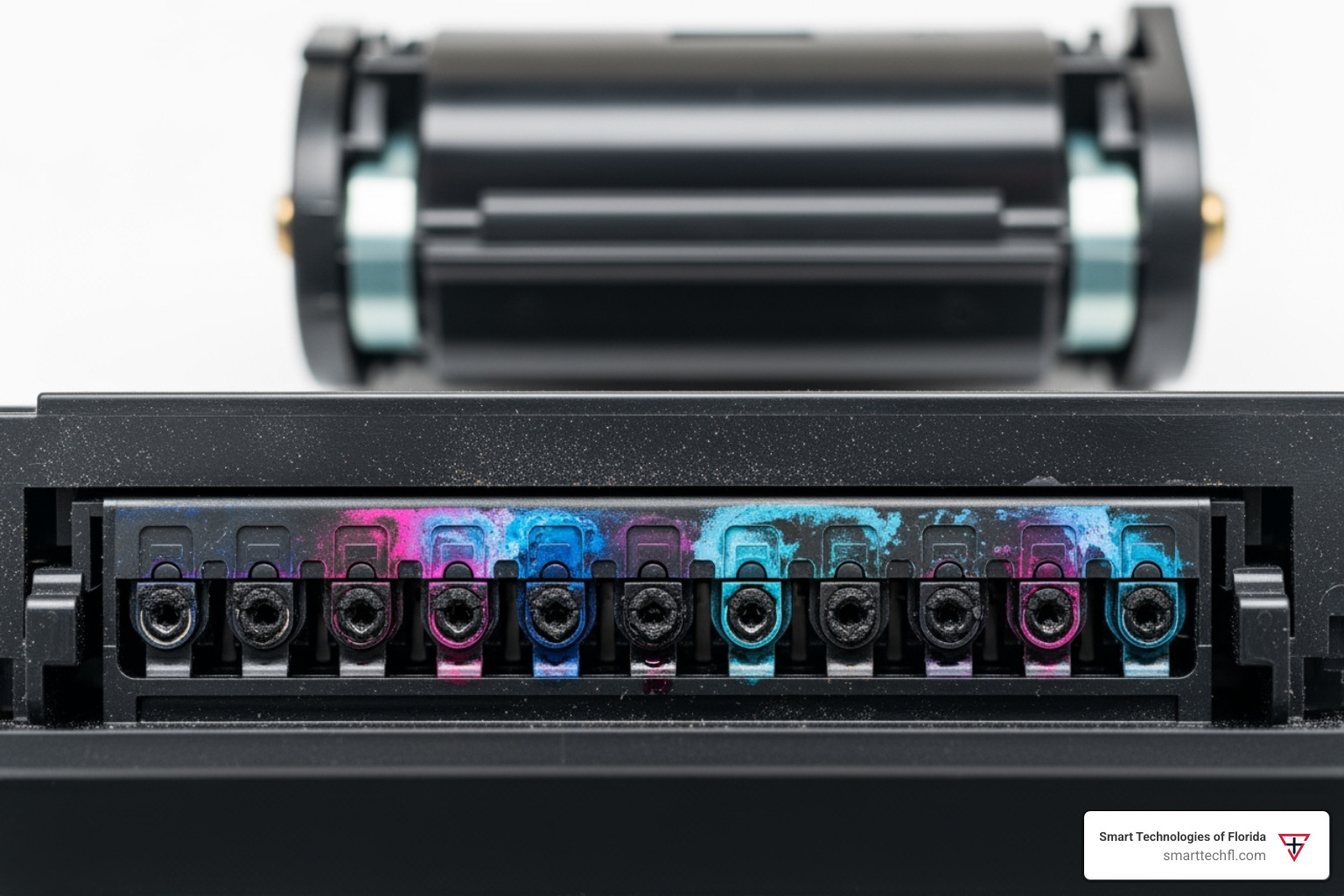
With inkjet printers, ink drying out is a common enemy. The liquid ink in the cartridges doesn’t wait patiently. If you don’t print regularly, it can dry up and clog the microscopic nozzles.
The result is that you throw away cartridges with plenty of ink left. We’ve seen business owners replace “full” cartridges simply because they became unusable after sitting idle.
It gets worse. Inkjet printers are notorious for wasting ink on cleaning cycles. Each time you power up your printer, it runs a cleaning cycle, shooting ink through the nozzles to keep them clear—ink that never makes it to your documents. Your printer is literally flushing money down the drain.
Toner doesn’t have these problems. Being a dry powder, it sits in its cartridge for months or years without degrading. No drying, clogging, or wasteful cleaning cycles. This toner stability is a huge factor in the durability of laser printers.
When you factor in a printer’s duty cycle—how many pages it’s designed to handle per month—laser printers typically handle three times the workload of inkjets. For a deeper dive into these ongoing costs, check out our guide on Laser Printer Maintenance Costs Explained.
The Infrequent User’s Problem: Dried Ink vs. Stable Toner
If you only print occasionally, inkjet printers can become financial quicksand. You need to print an important document after a couple of months, but your inkjet only produces streaky, faded lines.
Why inkjets are problematic for occasional use comes down to physics. Liquid inks need regular use to keep flowing; otherwise, the cartridges become expensive paperweights. You end up buying new cartridges not because they’re empty, but because they’ve become unusable.
We’ve heard from customers who replaced 90% full cartridges simply because they hadn’t printed in two months. That’s not a printing cost; it’s throwing money away.
Toner’s long shelf life changes everything. Since it’s a dry powder, it can sit unused for years without problems. We’ve seen laser printers from 2005 still working perfectly years later with the same toner cartridge.
This gives you peace of mind with laser technology. Whether you print weekly or every six months, your laser printer will be ready without the drama or wasted costs from replacing dried-out cartridges.
The High-Volume User’s Advantage: Speed and Durability
For businesses that print regularly, the speed difference alone can justify choosing laser. While inkjets crawl along at 5-20 pages per minute, laser printers zoom through documents at 20-100 pages per minute. When printing reports or invoices, that speed translates directly into productivity.
But speed is just the beginning. How laser printers handle business workloads is where they really shine. Their printer duty cycle is typically three times higher than inkjets. They’re workhorses designed for the demands of a busy office.
Consider this: according to industry research on office printing habits, the average employee prints about 34 pages daily. Over a month, that’s over 1,000 pages per person. Multiply that by your team, and you see why a laser printer’s durability and speed are essential for business productivity.
For high-volume printing, laser printers save money on consumables, save time, reduce downtime, and eliminate maintenance frustrations.
The Game Changer: How Ink Tank Printers Disrupt the Debate
Just when you thought you had the printing world figured out, a new technology arrived. Enter the ink tank printer, the newcomer making both laser and traditional inkjet manufacturers nervous.
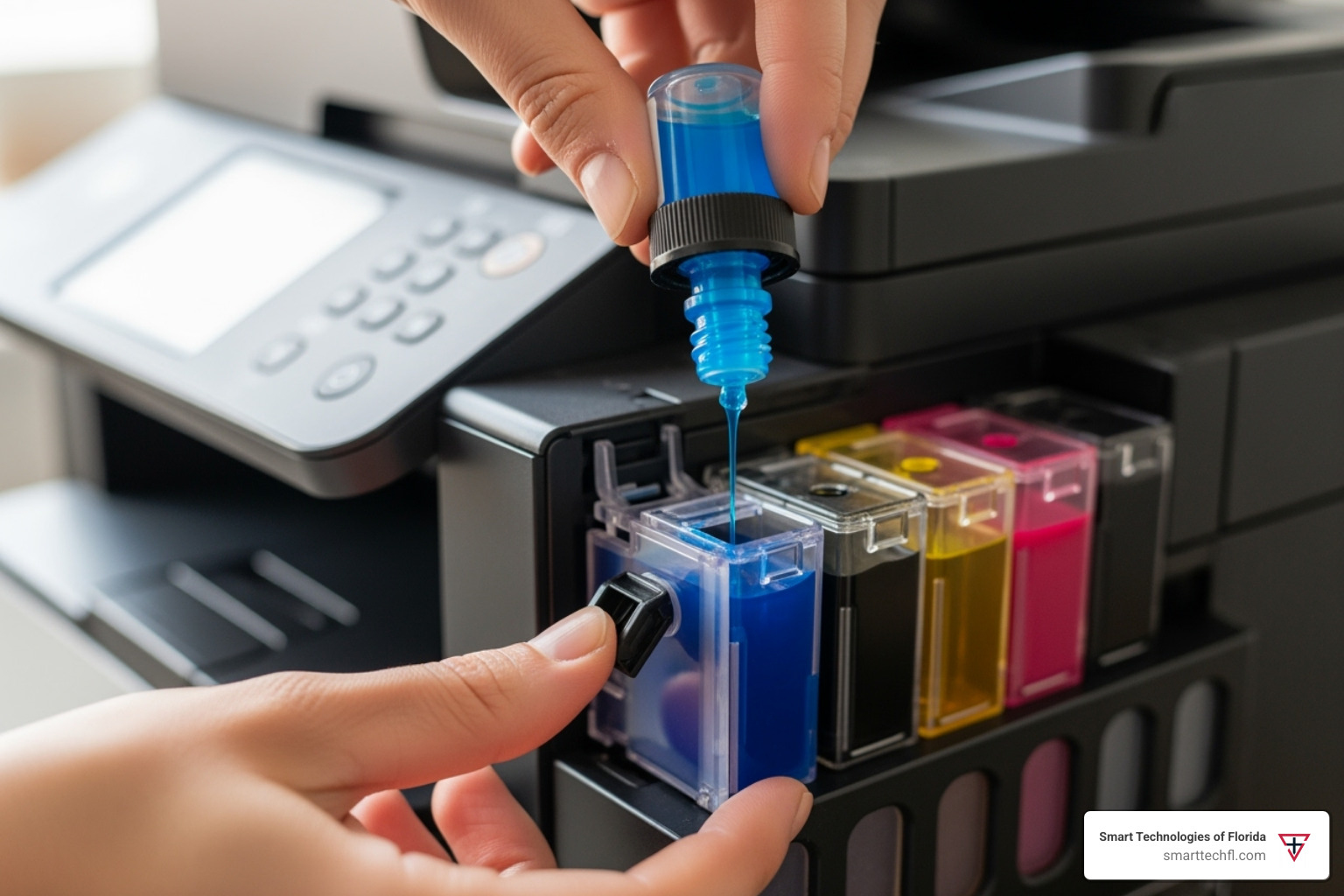
Think of ink tank printers as the rebel of the inkjet family. They kept the best inkjet features—vibrant colors, photo-quality prints, and paper versatility—but ditched the tiny, overpriced cartridges.
Instead of buying new plastic cartridges, you simply refill large, built-in tanks with affordable ink bottles. This continuous ink supply system breaks the traditional “razor and blades” business model.
The economics are impressive. Where a traditional inkjet cartridge gives you 200 pages for $20, an ink tank system can deliver 6,000 to 7,700 color pages from a single $25 bottle refill. This represents a complete paradigm shift in printing costs.
For those curious about similar innovations in laser technology, our guide on Refillable Ink Laser Printers: Cost Benefits explores related cost-saving approaches, though ink tank technology primarily applies to inkjet systems.
Are laser printers cheaper than ink refills when ink tanks are an option?
This question just got more interesting. Are laser printers cheaper than ink refills when ink tanks enter the picture? The answer depends on what and how much you print.
For black and white documents, some ink tank models achieve the impossible. The Canon Pixma G6020 MegaTank, for example, prints black pages for around 0.2 cents each. That’s cheaper than most laser options, which typically cost 2-5 cents per black page.
But color printing is where ink tanks really flex their muscles. While color laser printing hovers around 15 cents per page, ink tank systems deliver vibrant color prints for just 5-10 cents per page. For businesses that need regular color documents, this difference adds up quickly.
A single $25 color ink bottle can print up to 7,700 pages. To match that, you’d need dozens of traditional inkjet cartridges, each costing $15-30.
Of course, there’s a catch. Ink tank printers typically cost $200-400 upfront, similar to laser printers. You’re paying more upfront to escape the cartridge trap.
There are also maintenance considerations. While ink tank systems are more reliable than cartridge inkjets, they still use liquid ink. This means occasional printhead cleaning and potential ink drying if left unused for months. However, larger ink reservoirs make these issues less severe than with traditional cartridges.
When is an ink tank the best choice? If you print frequently, need lots of color, or want the absolute lowest cost per page, ink tank printers deserve serious consideration. They’re particularly brilliant for small businesses, creative professionals, and families.
The technology has matured, and reliability concerns are largely in the past, making ink tanks a legitimate challenger to both traditional inkjets and laser printers.
Frequently Asked Questions about Printer Costs
Let’s address the most common questions from business owners trying to figure out if are laser printers cheaper than ink refills for their specific situation.
Which printer type is cheaper if I barely print?
Surprisingly, if you only print occasionally, a monochrome laser printer is often your best financial bet. While they cost more upfront, there’s a catch with inkjets that infrequent users find too late.
Inkjet ink has a nasty habit of drying out. You buy a $100 inkjet, use it twice, and six months later the cartridges have become expensive paperweights. The ink has dried in the nozzles, forcing you to buy new cartridges even if the old ones were barely used.
Toner, on the other hand, is a dry powder that can sit in your printer for years without issues. So even if you only print a few pages every few months, your laser printer will be ready when you need it.
Can I save money with third-party or refilled cartridges?
Absolutely! This is one of the best ways to slash printing costs for both inkjet and laser printers. Many clients report saving 50% or more by switching to compatible cartridges from reputable suppliers.
The savings are often more dramatic with laser printers. Compatible toner cartridges can cost a fraction of what the manufacturer charges and typically work just as well. Some printer brands (like Brother) work well with third-party supplies, while others try to block them with security chips.
Here’s the important part: stick with reputable suppliers. Cheap cartridges from questionable sources can leak, produce poor-quality prints, or damage your printer. The goal is to save money, not create expensive problems.
For detailed guidance on navigating your options safely, check out our guide on printer cartridge refill benefits and costs.
What is more important: the printer’s price or the refill cost?
The refill cost wins every time. This is the most crucial lesson for anyone asking whether are laser printers cheaper than ink refills.
Think of it this way: you buy the printer once, but you’ll buy refills dozens of times. A $60 printer at 15 cents per page will demolish your budget compared to a $300 printer at 3 cents per page.
The magic number to focus on is “cost per page.” Take the cartridge price and divide it by its page yield. That tiny number is what really matters for your wallet. A cheap printer with expensive refills is like buying a car based only on its sticker price while ignoring its poor gas mileage.
This is how the “razor and blades” business model works. They hook you with a low printer price, then profit from the expensive consumables you’ll need for years. Don’t fall for it; always calculate the total cost of ownership before deciding.
The Verdict: Choosing the Right Technology for Your Needs
After reviewing the numbers, maintenance costs, and real-world scenarios, the answer to are laser printers cheaper than ink refills is clear: absolutely yes, especially for black and white printing and high-volume users. However, ink tank printers have shaken up this comparison, offering ultra-low costs that can even beat laser printers in certain situations.
Choosing the right printer isn’t just about the cheapest upfront option. It’s about understanding your total cost of ownership and matching the technology to your printing habits. Like buying a car, you wouldn’t choose based solely on the sticker price without considering gas mileage, maintenance, and how you’ll use it.
Traditional inkjet printers make sense if you’re printing a few pages per month, need the lowest upfront cost, or occasionally print high-quality photos on special paper. Just be prepared for the frustration of dried-out cartridges if you don’t print regularly.
Laser printers are your best bet when you’re printing frequently, dealing mostly with text documents, or running a busy office where speed and reliability matter. An average of 34 pages per day is laser printer territory. The toner won’t dry out, and these machines are built to handle the workload.
Ink tank printers have become the dark horse in this race. If you print high volumes of both black and color documents, enjoy printing photos, or want the absolute lowest cost per page, these newer systems deliver significant savings. They cost more upfront, but refill bottles print thousands of pages for the price of a few traditional cartridges.
The key insight here is that this choice represents a strategic investment in your business productivity. At Smart Technologies of Florida, we’ve spent 23 years helping businesses steer these exact decisions. Our people-centric approach means we don’t just hand you a spec sheet. We sit down with you, understand how your team works, and help you choose technology that supports your goals.
Don’t fall into the trap of that attractive $60 price tag on a basic inkjet. Making an informed decision based on your real printing needs will save you hundreds, if not thousands, of dollars over the printer’s lifetime. Your future self will thank you for thinking beyond the initial purchase price.
Ready to stop overpaying for printing? Let us help you Find the right printing solution for your business that makes financial sense for your specific needs.
Related Posts
— Wide Format Wonders: Printers That Stretch Your Ink Budget
— The Key Features of Inkjet Printers: A Deep Dive